
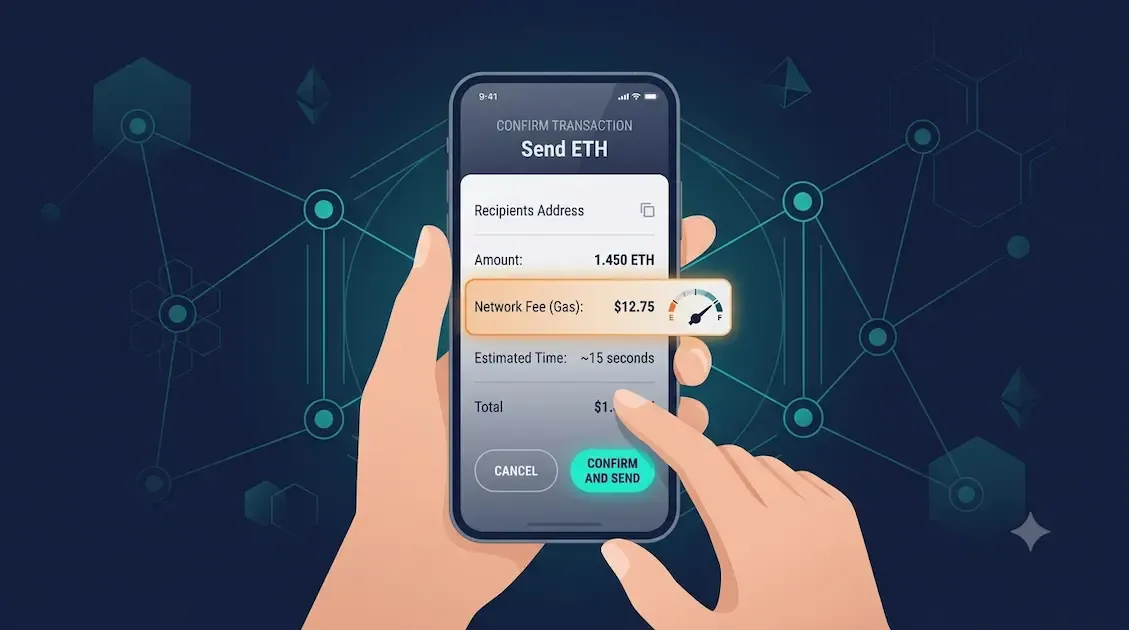
Confused about what is gas fee in crypto? Learn how gas fees are calculated, why they spike, and how to avoid overpaying — explained simply.
You go to send crypto or mint an NFT, and right before you confirm, you see it: a fee that seems to come out of nowhere, sometimes bigger than the transaction itself. If you’ve ever paused and thought “wait, what is gas fee in crypto, and why am I paying it?” — you’re far from alone. It’s one of the most common points of confusion for anyone new to blockchain.
The good news: gas fees aren’t random, and they aren’t a scam. They follow a logical (if slightly technical) system. In this guide, you’ll learn exactly what a gas fee is, how gas fees are calculated, why they spike unpredictably, and practical ways to avoid overpaying. This article is purely educational — we’re not a trading or exchange platform, so there’s no product being pushed here, just a clear explanation.
What Is Gas Fee in Crypto, Really?
A gas fee is the cost you pay to have your transaction processed and validated on a blockchain network. Think of it like a toll on a highway: the “highway” is the blockchain, and the toll is what you pay to the people (or more accurately, the computers) maintaining and securing that highway.
The term “gas” originated with Ethereum, where every action on the network — sending tokens, interacting with a smart contract, minting an NFT — requires a certain amount of computational effort. That effort has a cost, and gas is the unit used to measure it.
Importantly, a gas fee explained for beginners boils down to one simple idea: you’re not paying a company, you’re paying the network — specifically, the validators (or miners, on older systems) who dedicate computing power to process and confirm transactions.
How Gas Fees Are Calculated
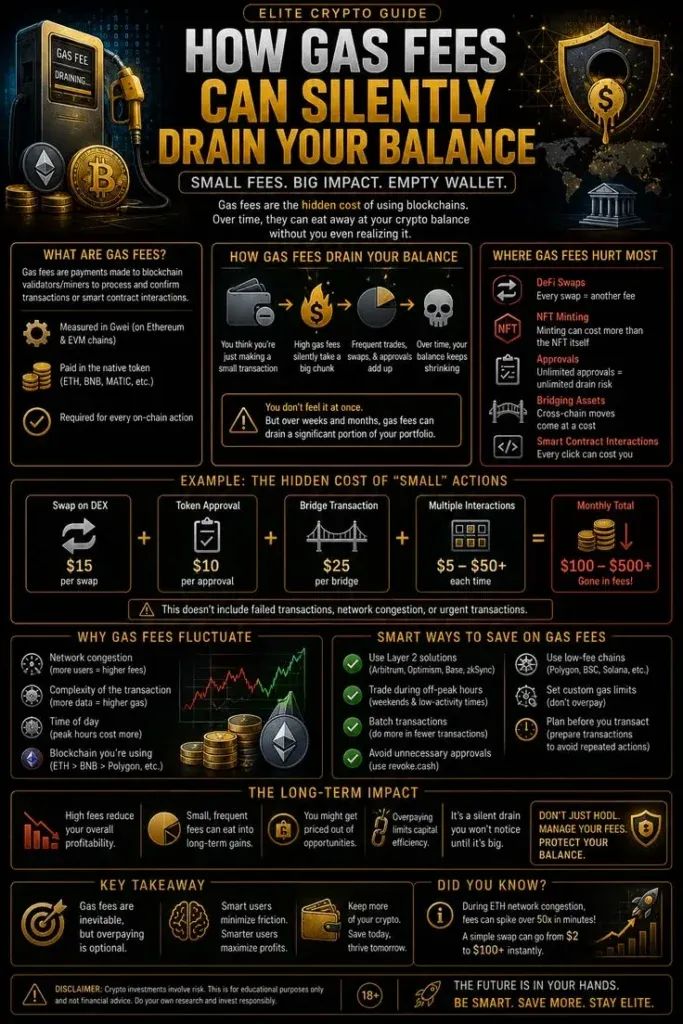
This is where most beginners get lost, so let’s break it into plain terms. On Ethereum and similar networks, your total gas fee generally comes from two things multiplied together:
Gas fee = Gas units required × Gas price per unit
- Gas units required: How much computational work your specific transaction needs. A simple token transfer needs relatively few units. A complex smart contract interaction (like an NFT mint or a multi-step swap) needs more.
- Gas price per unit: How much you’re paying per unit of that work, usually measured in a small denomination called “gwei.” This price fluctuates constantly based on how busy the network is.
So when people ask how gas fees are calculated, the honest answer is: it’s a combination of transaction complexity and real-time network demand — not a flat, fixed rate.
A Simple Example
Imagine two people using Ethereum at the same time:
- Person A sends a basic token transfer — low complexity, fewer gas units needed.
- Person B mints an NFT through a smart contract — higher complexity, more gas units needed.
Even if both transactions happen in the same 10-second window, Person B will almost always pay a higher gas fee, because their transaction requires more computational work, not because they were charged unfairly.
Why Gas Fees Spike (and Why They’re Unpredictable)
Gas prices work similarly to surge pricing on a rideshare app. When network demand is low, gas prices per unit drop, since there’s plenty of space for everyone’s transaction. When demand spikes — during a popular NFT drop, a major token launch, or a broader market rally — everyone is competing for limited block space, and gas prices rise sharply.
This is why the same transaction that cost a few cents on a quiet Tuesday might cost several dollars during a high-traffic event. It’s not the network changing its rules; it’s simple supply and demand.
Gas Fee Explained for Beginners: Key Terms You’ll See
- Gwei: The small unit gas prices are measured in (1 gwei = 0.000000001 ETH).
- Base fee: A network-set minimum fee that adjusts automatically based on demand (used on Ethereum since the London upgrade).
- Priority fee (tip): An optional extra amount you can add to encourage validators to process your transaction faster.
- Gas limit: The maximum amount of gas you’re willing to allow for a transaction — a safety cap, not the amount you’re guaranteed to pay.
Knowing these terms makes wallet fee screens far less intimidating, since most wallets show some combination of these values before you confirm a transaction.
How EIP-1559 Changed the Way Gas Fees Work
If you’ve used Ethereum for a while, you may have heard of a network upgrade called EIP-1559, introduced in 2021. Before this upgrade, gas prices worked as a pure auction — everyone bid what they thought would get their transaction processed, which made fees hard to predict and often led to overpaying “just in case.”
EIP-1559 changed this by splitting the fee into two parts:
- A base fee, which is set algorithmically by the network itself based on how full recent blocks have been. This portion is actually burned (permanently removed from circulation) rather than paid to a validator.
- A priority fee (tip), which you set to incentivize validators to prioritize your transaction over others.
This system made gas fee explained for beginners a bit more approachable, since wallets can now estimate the base fee fairly accurately and simply ask you how large a tip you’d like to add. It also made fees somewhat more predictable overall, even though they can still spike sharply during high-demand periods.
Other networks have since adopted similar or comparable fee models, though the exact mechanics vary. This is part of why it’s worth checking a given blockchain’s specific documentation rather than assuming every network calculates fees identically to Ethereum.
How to Estimate a Gas Fee Before You Confirm a Transaction
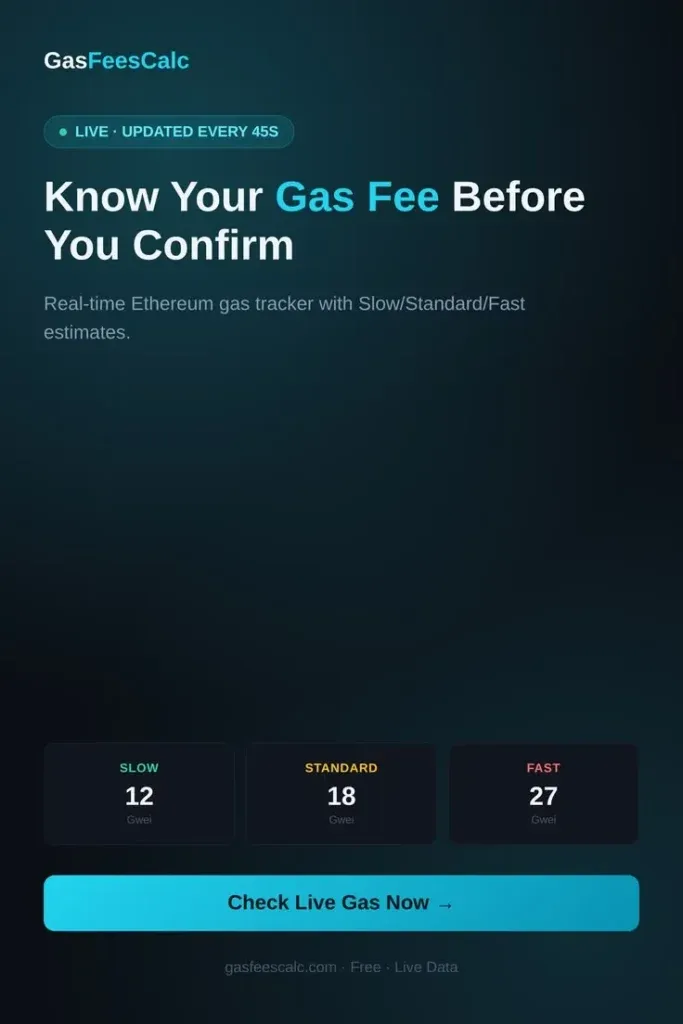
Most modern wallets do this estimation for you automatically, but it helps to understand what’s happening behind the scenes:
- The wallet checks current network conditions — essentially, how congested the network is right now.
- It estimates the gas units your specific transaction will need — based on the type of action (simple transfer vs. smart contract call).
- It suggests a base fee and priority fee — usually with a few speed options, such as “slow,” “average,” and “fast.”
- You confirm or manually adjust — some wallets let advanced users manually edit the gas price or gas limit, though this isn’t necessary for most everyday transactions.
If a wallet’s estimate seems unusually high, it’s often worth checking a live gas tracker independently before confirming — sometimes wallet estimates are conservative (padded higher for safety), and a slightly lower manual setting can still process the transaction successfully, just marginally slower.
Do All Blockchains Have Gas Fees?
Not exactly the same way. Ethereum popularized the term “gas,” but most blockchains have some version of a transaction fee:
- Bitcoin uses a fee market based on transaction size (in bytes) rather than computational complexity.
- Newer Layer 1 and Layer 2 networks are often specifically designed for lower, more predictable fees, since high gas costs were one of the biggest complaints about early Ethereum usage.
If you’re comparing networks, it’s worth checking each one’s fee structure individually rather than assuming they all work identically. A transaction that costs a few cents on one network could cost several dollars on another, purely due to differences in design, not because one network is inherently “better.”
Real-World Fee Comparison Snapshot
To put this in perspective, here’s a general (non-exhaustive) sense of how fee structures tend to differ:
- Ethereum mainnet: Fees fluctuate the most, since gas price is driven directly by real-time demand and can range from under a dollar to well over $50 during extreme congestion.
- Bitcoin: Fees are generally more predictable but still rise during high network activity, calculated based on transaction size in bytes rather than smart contract complexity.
- Layer 2 networks: Typically offer fees a fraction of Ethereum mainnet costs, often just a few cents, since they batch many transactions together before settling on the main chain.
These figures shift constantly, so always check a live gas tracker rather than relying on fixed numbers from an article — including this one.
How to Avoid Overpaying on Gas Fees
- Time your transactions: Network activity (and therefore gas prices) often dips during off-peak hours, such as late night or early morning in the network’s most active regions. Weekends can also see lower average gas prices compared to weekdays, though this isn’t guaranteed.
- Check current gas prices before confirming: Many wallets and third-party gas trackers show real-time price estimates so you’re not guessing. Some trackers even show historical charts, so you can spot patterns in when fees tend to be lowest.
- Avoid unnecessary complex transactions: Simple transfers cost less than multi-step smart contract interactions, so batching or simplifying actions where possible can help. For example, approving a token for spending and then swapping it are technically two separate transactions with two separate gas costs — some newer wallet interfaces try to streamline this, but it’s still worth being aware of.
- Consider Layer 2 networks: Many popular applications now offer Layer 2 versions specifically to reduce gas costs for everyday users. These networks handle the bulk of transaction processing off the main chain, then settle in batches, which significantly cuts individual costs.
- Double-check your gas limit setting: Setting the gas limit too low can cause a transaction to fail entirely, sometimes without refunding the gas already spent on the attempt. Most wallets suggest a reasonable default, but it’s worth understanding what that number represents rather than blindly accepting or editing it. (Setting your gas price too low, on the other hand, doesn’t cause a failure — it’s actually one of the main reasons transactions end up stuck in a pending status for an unusually long time.)
Common Gas Fee Mistakes Beginners Make
- Confirming transactions during peak hours without checking a gas tracker first — often the single biggest cause of an unexpectedly high fee.
- Misunderstanding the gas limit as a guaranteed cost — the gas limit is a ceiling, not a bill; you generally only pay for the gas actually used, with unused gas refunded.
- Assuming all networks charge gas the same way — someone used to Ethereum’s fee structure can be caught off guard by how differently Bitcoin or a Layer 2 network calculates cost.
- Ignoring the priority fee (tip) during time-sensitive transactions — for something urgent, like an NFT mint with a limited supply, a low priority fee can mean your transaction confirms too late, even if the base fee was covered.
- Not accounting for gas fees when calculating total transaction cost — especially relevant for smaller transfers, where the gas fee can represent a disproportionately large percentage of the total amount being sent.
Why Understanding Gas Fees Matters Long-Term
Beyond avoiding a one-time overpayment, understanding what is gas fee in crypto helps with bigger-picture decisions too. If you’re regularly interacting with decentralized applications, gas costs can add up significantly over time, and factoring them into your overall activity (not just individual transactions) gives a much clearer picture of the real cost of using a given network.
This is also part of why so many projects have moved toward Layer 2 solutions and alternative blockchains in recent years — high and unpredictable gas fees were, for a long time, one of the most-cited barriers to everyday blockchain use. Understanding how gas fees are calculated isn’t just trivia; it’s a practical skill that carries over to nearly every blockchain interaction you’ll ever make, from simple transfers to complex DeFi activity.
Frequently Asked Questions
1. What is gas fee in crypto in the simplest terms?
It’s the fee you pay for the computational work needed to process your transaction on a blockchain network — similar to a toll for using the network’s processing power.
2. How gas fees are calculated exactly?
Gas fees are generally calculated by multiplying the gas units your transaction requires by the current gas price per unit, which fluctuates based on network demand.
3. Why did my gas fee suddenly increase?
Sudden increases usually reflect a spike in network demand — such as a popular NFT mint or token launch — where many users are competing for limited block space at the same time.
4. Can I set my own gas fee?
On networks like Ethereum, you can often adjust the priority fee (tip) to speed up processing, but setting it too low risks a delayed or stuck transaction, and setting the gas limit too low can cause the transaction to fail.
5. Is a high gas fee a sign of a scam?
No — gas fees go to the network, not to any individual party, and high fees during busy periods are a normal (if frustrating) part of blockchain economics, not a sign of fraud.
6. Do gas fees ever get refunded?
Partially, yes. If a transaction uses less gas than the gas limit you set, the unused portion is typically refunded automatically. However, if a transaction fails after execution has already begun, the gas used up to that point is usually not refundable, since the computational work was still performed.
7. Why do gas fees vary so much between different times of day?
Gas fees closely track network activity, and activity patterns often follow regional usage habits — for example, periods of heavy trading or NFT activity in certain time zones can drive up demand temporarily. There’s no universal “cheapest hour,” but checking a live tracker before larger transactions can help you spot lower-cost windows.
Final Thoughts
Once you understand what a gas fee actually is — a payment for computational work, not an arbitrary charge — the whole system becomes much less confusing. Knowing how gas fees are calculated and why they spike also helps you time your transactions more wisely and avoid unnecessary costs.
Want to keep building your crypto literacy?
Check out our related guides on why crypto transactions get stuck in pending status and wallet types explained (internal link placeholders) to understand more of the “why” behind everyday crypto confusion.


Безопасное увлечение ставками — это практика, ориентированный на сохранение меры над своими решениями и понимание негативных последствий, связанных с игровой деятельностью, при параллельном упоминании на досуг как главную причину участия.
https://randx-super.ru/
На представленном веб-сайте можно отыскать обилие практичной материалов.
https://e-transavto.ru/read/khusity-zafiksirovali-udary-po-dvum-saudovskim-neftyanym-tankeram-v-razgar-amerikanskogo-garnizona-u-iranskikh-beregov-537/
555
555
Осознанный гемблинг — это система, предназначенный на обеспечение меры над игровым поведением и осознание потенциальных проблем, сопутствующих с азартными играми, при одновременном упоминании на развлечение как главную функцию участия.
https://randx-super.ru/
На данном сайте можно обнаружить обилие ценной информации.
https://fe-style.ru/style/1808-ekologicheskaya-otvetstvennost-balenciaga-ustoychivye-praktiki-v-proizvodstve-sumok
Разумное участие в играх — это метод, предназначенный на сохранение меры над игровым поведением и осознание потенциальных проблем, сопутствующих с азартными играми, при одновременном упоминании на досуг как базовую причину участия.
https://randx-super.ru/
На данном портале есть возможность обнаружить массу практичной информации.
https://1-mk.ru/detail/524-torzhestvennyy-den-abazskoy-kultury-oznamenoval-god-edinstva-narodov-rossii-v-cherkesske/
На данном ресурсе можно найти обилие полезной информации.
https://www.dnnsoftware.com/activity-feed/my-profile/userid/3315038
На этом портале есть возможность обнаружить много полезной информации.
https://altrades.ru/finance/168-kak-jimmy-choo-izmenil-predstavlenie-o-zhenskoy-obuvi-v-kontse-xx-veka.html
Тут веб-сайте можно почерпнуть важную информацию.
https://www.reddit.com/user/Rare_Ad6396/
Тут портале есть шанс найти нужную информацию.
https://for-el.ru/doc/968-v-menya-vlozhili-million-dollarov-o-tsene-professionalnogo-tennisa-borbe-s-psikhologicheskim-gnetom-i-vstreche-s-legendoy.html
На этом веб-сайте можно найти важную информацию.
https://kupiraba.ru/page/2026-06-09-kak-vybrat-nadyozhnoe-onlayn-kazino-proverka-litsenziy-otzyvov-i-metodov-platezhey.html
На данном сайте вы сможете обнаружить интересную информацию.
https://kart1na.ru/entry/315-tramp-i-rossiya-kak-amerikanskiy-politik-okazalsya-v-tsentre-obsuzhdeniya-sudby-ryabkova/
На этом веб-сайте можно найти ценную информацию.
https://dvery35.ru/article/4363-effektivnye-strategii-dlya-igry-v-ruletku-na-randx.html
На данном ресурсе есть шанс почерпнуть нужную информацию.
https://relax-spb.ru/read-info/3095-kaluzhskaya-karatistka-vzyala-serebro-v-spartakiade-uchashchikhsya-rossii-final-xiii-letnego-turnira.html
Тут портале вы сможете найти интересную информацию.
https://homirussia.ru/
Тут портале вы сможете найти ценную информацию.
https://liveforsport.ru/full-text/1791-tri-desyatka-let-nazad-oleg-tabakov-zovyot-k-nezavisimosti-svobode-i-eltsinu-na-stadione-lokomotiv.html
На этом портале можно получить важную информацию.
https://histblog.meatmoda.ru/pdQ6bZg19YBG/
Прокси-сервер и VPN — это средства, применяемые для скрытия реального сетевого адреса юзера.
Они предоставляют анонимность в интернете и оберегают приватность от посторонних.
Основное отличие в том состоит в что прокси действует на уровне конкретных приложений, а VPN — шифрует весь интернет-трафик.
Соответственно, прокси больше подходит для преодоления блокировок ресурсов, а второе решение — для всесторонней безопасности и гарантии полной анонимности.
https://proxyvpn.uk/